


… in the Minneapolis Star Tribune notes that the most charitable description of what’s been going on at the clubby University of Minnesota medical school would be “bizarre.”
Thursday, August 16, 2018
State Senator John Marty's letter to the Board of Regents Regarding Separation Payment to University of Minnesota President Kahler
The Periodic Table has obtained a copy of the following letter. It seems relevant to those of us who care about our university.

Senator John Marty at right.
To Chair McMillan and the Members of the Univ of Minnesota Regents from MN Senator John Marty by Bill Gleason on Scribd
To download a pdf of this letter click the button marked "arrow down." (third symbol from the right.) To get a larger size of the letter to read on screen, click the first symbol on the right (four arrows).


Tuesday, May 15, 2018
Goodbye, Mr. Chips

The U of M administration recently presented the 2018 annual report on employee compensation to the Regents. The vice president for human resources "compared higher education to the private sector . . . ." One of the Regents observed that the administration is "paying many employees far higher than the state or county does." The vice president responded that "most employees come from private industry and not from the state." See pp.5--7 of the March 2018 BOR Docket.
The Minnesota Council of Nonprofits notes that the public expects that non-profit organizations will avoid paying high salaries and benefits in order to concentrate their funds on the charitable and educational purposes of the organizations. See, Executive Compensation Best Practices.
The University of Minnesota observed this principle for its first 150 years. Then the U of M was transformed into University Inc.
In 2003 the legislature cut state appropriations to the University. Rather than making adjustments to the university budget and raising tuition slightly, then President Bruininks adopted (either by design or in effect) a high tuition high financial aid model. See the June 16, 2011 Minnesota Monthly report on The Man Who Slew the U.
The high tuition high financial aid experiment has been a disaster for students and their parents. This was a predictable result of the experiment as college administrators classify student loans as "financial aid."
In the years that followed tuition increases (for undergraduate and graduate students and students in the professional schools) continued on a sharp upward trajectory. See the U.S. Labor Department chart at the beginning of The (Over) Billion Dollar Administration. This occurred even in years when the legislature increased appropriations.
Along the way the dollars required to feed the beast of administration increased substantially. By the end of his term Bruininks was receiving an annual salary of $750,000 plus an annual contribution of $100,000 to his retirement account (plus free housing). Then he gave bonus payments of hundreds of thousands of dollars to each of several departing senior administrators and accepted a $455,000 payment for a one year vacation for himself. See the reports from the Star Tribune and from the Pioneer Press reprinted at: U Execs Paid Handsomely on Way Out; and Vacation Pay $455,000.
The defense to the high spending on administration is that it is necessary to attract "top talent." The senior administrators bring in compensation consultants to show that their compensation is comparable to that of administrators at other large universities. But the comparison is in a closed system that does not consider compensation in other positions of public service that require similar qualifications and have similar duties. And the compensation consultants come from the very few firms that cater to institutions of higher education. So they make recommendations that are very favorable to senior administrators who then refer the firms to their fellow administrators at other universities and who also hire the firms for other matters. The consulting firms know who butters their bread.
A couple of years ago the U of M administration retained Sibson Consulting of New York to provide a "spans and layers" analysis. At the time the Sibson web site had this description for an upcoming presentation:
"Incentives are becoming more common in higher education, as institutions seek creative compensation to reward for performance, excellence and attract and engage highly qualified talent. Join us for an interactive discussion on how incentives have been successfully implemented in some institutions, and what you can do to introduce this concept in your organization."
The New Reality: Incentives in Academia
(Sibson Consulting) (emphasis added).
There are about 40 vice presidents (at senior, associate, and assistant levels) at the U of M. At the senior level some of the annual salaries are hundreds of thousands of dollars greater than the annual salaries of the commissioners who serve as the chief executive officers of state departments (with annual salaries around $145,000). Here are a few examples: senior vice president for finance at the U of M, $410,000; executive vice president and provost, $446,000; director of the Institute for Health Informatics, $410,000; vice president for equity & diversity, $241,00; general counsel, $300,000. At the associate VP level the annual salaries are tens of thousands of dollars greater than the annual salaries of state commissioners. The total compensation for these senior university administrators, including deferred compensation and other substantial employee benefits, is even greater.
We need to develop a different way to operate and to finance higher education. See A Modest Proposal.
Michael W. McNabb
University of Minnesota B.A. 1971; J.D. 1974
University of Minnesota Alumni Association life member
Tuesday, March 6, 2018
A Modest Proposal
On Operating and Financing Higher Education
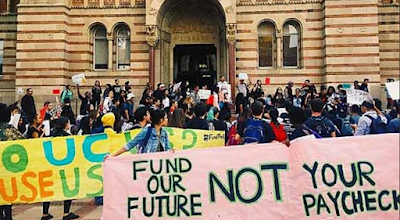
A Modest Proposal
National student loan debt is at $1.3 trillion and rising. See the February 21, 2017 Forbes magazine report on A $1.3 Trillion Crisis. This debt is incurred after students (and their parents) have already exhausted their savings and student earnings.
More than 60% of the students who received their Bachelors' degrees from the University of Minnesota in 2016 also received a bill for student loans. The median amount of debt was more than $24,000. See p. 20 of the November 2017 Minnesota Office of Higher Education report on Cumulative Student Loan Debt in Minnesota.
The reliance on student loan debt to finance much of higher education must end. Tuition should be collected from revenues that the students earn after graduation. The amount of tuition should be a percentage of the earnings of each student for a certain time period, such as five years. This would also inject a much needed dose of accountability into the system.
Our current system of financing higher education places all the risk on students, their parents, and the public (by way of state appropriations). It has plenty of financial incentives for advancing into the upper ranks of the administrative bureaucracy at the university and few for providing an education of value to undergraduate students (by either a monetary or non-monetary measure of value).
University administrators have failed to exercise sound financial management in the use of tuition and state appropriations. In a 2012 report the consulting firm Bain & Co. observed that the operating principle for universities has been the Law of More:
Many institutions [of higher education] have operated on the assumption that the more they build, spend, diversify and expand, the more they will persist and prosper. But instead the opposite has happened. Institutions have become over leveraged. Their long term debt is increasing at an average rate of approximately 12% per year, and their average annual interest expense is growing at almost twice the rate of their instruction-related expenses (see Figure 5). In addition to growing debt, administrative and student service costs are growing faster than instructional costs. And fixed costs and overhead consume a growing share of the pie (see Figure 6).See p. 3 of The Financially Sustainable University (emphasis added).
In fiscal year 2017 the U of M administration spent almost $289 million on "leadership & oversight" and more than $713 million on "mission support" (excluding the costs of facilities and debt service). Those costs of administration exceeded $1 billion and consumed 27% of the $3.7 billion university budget. See The (Over) Billion Dollar Administration.
We can no longer afford to entrust university administrators with hundreds of millions of dollars in unconditional allocations of general appropriations each year. Nor should there be unconditional allocations of additional hundreds of millions of dollars in HEAPR funds to remedy the decades long failure of the administration to allocate sufficient university funds for the maintenance of academic facilities. See Falling (Far) Behind Part II.
The legislature may impose reasonable and effective conditions on state appropriations to the U of M. As the Minnesota Supreme Court has noted:
Discussing the scope of the legislature's authority in light of the University's constitutional autonomy, we explained in Chase: "At the one extreme the Legislature has no power to make effective, in the form of law, a mere direction of academic policy or administration. At the other extreme it has the undoubted right within reason to condition appropriations as it sees fit." 175 Minn. at 268, 220 N.W. at 955.Star Tribune Co. v. University of Minnesota Board of Regents, 683 N.W.2d 274, 285 (Minn. 2004) (emphasis added).
The Affordable Care Act requires health insurance companies in large group markets to send rebates to customers if administrative costs and profits consume more than 15% of premiums. See the August 17, 2014 Star Tribune report on Health Insurers Must Pay Up Or Pay Back. In a similar manner, the legislature should impose a condition on general appropriations and on HEAPR appropriations that would require the U of M administration to send rebates to the state treasury if the costs of administration (as defined by the legislature) exceed 15% of total expenses.
In fiscal year 2017 the total expenses of the University were $3.7 billion. Spending 15% of that amount on costs of administration would consume $555 million. More than half a billion dollars is more than reasonable for administrative overhead.
Acts of reckless endangerment by the leaders of large financial institutions produced the Great Recession. The federal government (finally) cracked down by imposing stress tests on those firms. The state legislature should impose similar tests on institutions of higher education that receive state appropriations. Those institutions should be subject to annual scrutiny by the legislative auditor and the Minnesota Office of Higher Education. The senior administrators of those institutions should also be required to certify annual reports on financial status and the use of state appropriations to the higher education committees of the state legislature.
We need to establish a task force in order to develop a different way to operate and to finance higher education. The work of the task force should include an analysis of the rise in the costs of administration at the U of M over the past 40 years. If there has been an increase in the number of administrators that is disproportionate to any increase in the number of students or the scope of research, we should ask why. If there has been a substantial increase (in constant dollars) in the compensation of any administrator, we should ask why.
We should also compare the compensation paid to university administrators to the compensation of officials in state government who have similar qualifications and duties. For example, the annual salary of the state commissioner of human rights is $145,000. The annual salary of the vice president of the U of M Office for Equity & Diversity is more than 50% greater at $241,000.
Just as the Wall Street bankers created a housing bubble using other people's money, the senior administrators and the Regents at the U of M have created a higher education bubble using both student loan debt and state appropriations. When this budget balloon bursts, they will walk away unscathed, just as the investment bankers did. The students (and their parents) will suffer harm from the student loan debt that inflated the balloon. They will be shackled with that debt for many years (or even decades for many students in the professional schools).
The Regents do not provide effective oversight. They rely on the senior administrators to sift through the volumes of information about the operations of the university. So (with perhaps a couple of exceptions) they see only the information selected by the administrators. They develop a bond with the senior administrators with whom they spend most of their time on campus. So as a group they tend to dismiss the perspectives of other persons (on the rare occasions when they hear other perspectives).
Each biennium the citizens of our state invest more than $1 billion in the U of M in general appropriations. With that much at stake the state legislature should appoint a qualified person to monitor the operations of the university and the use of state appropriations on a continuing basis. This legislative liaison (or watchdog) should have the responsibility to review information produced by senior administrators, to collect additional information through independent research, and to meet with all groups at the university so that the perspectives of other well-informed and thoughtful members of the university community are presented to the legislature.
Michael W. McNabb
University of Minnesota B.A. 1971; J.D. 1974
University of Minnesota Alumni Association life member
University of Minnesota Alumni Association life member
Friday, January 19, 2018
The Billion Dollar (+) Administration

The (Over) Billion Dollar Administration
In December the University of Minnesota administration released its Administrative Cost Benchmarking Report for fiscal year 2017. The Expense Summary in the Report is a list of expenses for three broad categories: (1) direct mission activities (instruction, research, and public service); (2) leadership & oversight; and (3) mission support & facilities. Here are the administrative expenses for the second and third categories:


See p. 9 of the December 2017 FIN Docket.
Note that this $1 billion tally of the costs of administration does not include the expenses for the direct mission activities of instruction, research, and public service. Nor does it include any spending on the costs of facilities or for debt service.
The total operating expenses of the university for fiscal year 2017 were $3.7 billion. See p. 324 of the December 2017 BOR Docket. So the $1 billion costs of administration account for 27% of those total expenses.
Is 27% in administrative overhead excessive? There is no national system for comparing administrative costs at universities so we have to look to the world outside the campus. With past administrative overhead of 20% American private health insurance companies had the highest administrative costs of any health insurance system in the world. See, T.R. Reid, The Healing of America (Penguin Press 2009) at pp. 36--38.
The Affordable Care Act now requires health insurance companies to send rebates to customers if administrative costs and profits consume more than a set percentage of premiums (20% for individual and small group markets and 15% for large group markets). See the August 17, 2014 Star Tribune report on Health Insurers Must Pay Up Or Pay Back.
It is likely that there would be an immediate and sharp reduction in the costs of administration if the legislature required the university to send rebates of state general appropriations to the state treasury if the U of M administrative costs exceeded 15% of its total expenses.
In 2014 the president of the university promised the state legislature to reduce administrative costs by $90 million over a six year period. This reduction is simply slowing (slightly) the rate of increase in the costs of administration which have skyrocketed over the past 20 years. For example, the spending just on personnel in the leadership & oversight category soared from $197 million in fiscal year 2015 to $245 million in fiscal year 2017.
The administration asserts that the costs of administration are less than 9% of the university budget. This calculation of spending on administration is limited to expenses in the leadership & oversight category. But in calculating any reduction in costs of administration to meet its six year $90 million promise to the legislature the administration counts any reductions in expenses in the mission support category. See pp. 41-42 of the Dec 2016 FIN Doc. And on the U of M web site the administration defines administrative costs as the combined costs for leadership & oversight and mission support. See Cutting Administrative Costs.
In the mission support category the administration spent almost $50 million on administrative consulting and professional services. The administration also spent almost $85 million more on consulting and professional services in the direct mission category. University administrators and consulting firms across the country have created a variation of the military-industrial complex.
We need to start to imagine a different way to operate and to finance higher education.
The state legislature should establish a task force with members of the higher education committees, university administrators and faculty and staff members, Minnesota Office of Higher Education staff members, and informed students and parents.
Each biennium the citizens of our state now invest more than $1 billion in the U of M in general appropriations. With that much at stake the legislature should appoint a qualified person to monitor the operations of the university and the use of state appropriations on a continuing basis. This legislative liaison (or watchdog) should have the responsibility to review information produced by senior administrators, to collect additional information through independent research, and to meet with all groups at the university so that the perspectives of other well-informed and thoughtful members of the university community are presented to the legislature.
Michael W. McNabb
University of Minnesota B.A. 1971; J.D. 1974
University of Minnesota Alumni Association life member
Tuesday, October 31, 2017
Crumbling Academic Infrastructure

Falling (Far) Behind Part II
"Now, here, you see, it takes all the running you can do to keep in the same place. If you want to get somewhere else, you must run at least twice as fast as that!"
Lewis Carroll, Through The Looking Glass (1871)
In the 2018 legislative session the U of M administration will submit a $200 million request for HEAPR funds to restore existing facilities--the largest such request ever made. See p. 11 of the SEP 2017 FIN Docket.
Almost one-third of the buildings on the Twin Cities campus (7.5 million square feet) are rated in poor or critical condition. See p. 9 of the SEP 2017 FIN Docket (above). In February 2016 a University assistant vice president reported that the administration should be spending twice as much as it currently spends simply to maintain University facilities in their current condition! See p. 8 of the February 23, 2016 Senate Committee on Finance & Planning report. It would cost a staggering $1 billion to restore all University facilities to at least fair condition. See p. 23 of the OCT 2014 BOR FRI Docket.
The administration acknowledges that the "growing deferred renewal backlog has widespread impacts on academic programs, research initiatives, student experience, and general competitiveness." See p. 41 of the SEP 2017 FIN Docket (above)(emphasis added).
This is the consequence of the decades long failure of the administration to allocate sufficient funds for the maintenance of academic facilities. At a recent meeting the University vice president responsible for infrastructure described to Regents how insufficient stewardship has increased the backlog of necessary maintenance. See p. 3 of the OCT 2017 BOR Docket.
During those same decades the costs of administration skyrocketed. In fiscal year 2016 those costs exceeded an astounding $993 million. See the January 26, 2017 commentary in the St. Paul Pioneer Press on The (Almost) Billion Dollar Administration. The current chair of the Board of Regents has declared that the current business model is unsustainable! See the final paragraph on p. 14 of the SEP 2017 BOR FRI Docket.
If it seems difficult to comprehend the magnitude of both the $1 billion backlog of deferred maintenance and the spending on administration, consider that a 50% reduction in the costs of administration would provide the funds to restore nearly all the University buildings in the first two years--even without any HEAPR funds from the legislature! And in the third year we could have a significant reduction in tuition. (Yes, we can. It just takes the will and the leadership to do so.)
Just as the maintenance of roads and bridges is an essential task for state and local governments, the maintenance of academic facilities should be a priority for an institution of higher education. We need an administration and a Board of Regents that will allocate the substantial resources of the University to the right priorities. See The (Almost) Billion Dollar Administration Part II.
Michael W. McNabb
University of Minnesota B.A. 1971; J.D. 1974
University of Minnesota Alumni Association life member
Monday, August 28, 2017
A Penchant for Secrecy Part II

A Penchant for Secrecy Part II
In September 2015 The Periodic Table described violations of the Open Meeting Law by the U of M administration. See, A Penchant for Secrecy.
The violations of the Open Meeting Law are continuing. See, for example:
July 13, 2017 No record of discussions during the 2017 annual retreat of Board of Regents (the second day of their July meeting).
May 4, 2017 The Faculty Consultative Committee (the major faculty committee) closed its meeting for discussion of a previous meeting with the Board of Regents chair and for a discussion of the University strategic plan; see section 2 at p. 2 of the May 4, 2017 FCC report.
March 21, 2017 The Senate Committee on Finance & Planning held an off the record discussion about the Board of Regents and direct management of the University; see section 4 at p. 6 of the March 21, 2017 SCFP report.
A paragraph of the Open Meeting Law requires that meetings of the governing body of a public body must be open to the public. Minn. Stat. 13D.01 subd. 1(b). In 2004 the Minnesota Supreme Court ruled that the U of M is a "public body" and applied the law to meetings of the Board of Regents (the governing body of the University). Star Tribune Co. v. University of Minnesota Board of Regents, 683 N.W.2d 274 (Minn. 2004).
The next paragraph of the Open Meeting Law requires that the meetings of any committee of a public body must be open to the public. Minn. Stat. 13D.01 subd. 1(c). In 2010 the former U of M general counsel attempted to limit the application of this paragraph with the argument that it applies only to committees that have authority to make final policy decisions (a distinction not found in the statute or in the opinion of the state supreme court). See the final paragraph on p. 4 of the September 16, 2010 FCC Report. This limitation would exempt most, if not all, committees, as committees usually only make recommendations to the governing body of an organization.
The argument of the former general counsel does not square with the statutory language that includes any committee of a public body in its scope. When the words of a statute are not ambiguous, the letter of the law may not be disregarded under the pretext of pursuing its spirit. Minn. Stat. 645.16. But the administration applies statutory language the same way as Humpty Dumpty, who said to Alice, "When I use a word, it means just what I choose it to mean--neither more nor less."
The failure to comply with the plain language of the statute does not serve the University well when the administration goes to the legislature to seek increases in state appropriations.
Michael W. McNabb
University of Minnesota B.A. 1971; J.D. 1974
University of Minnesota Alumni Association life member
Monday, June 5, 2017
Twenty questions for politicians about healthcare

Editors Note: The following material has been provided to me by my sister Eileen Gleason. Eileen is a retired federal prosecutor and has also been a judge and in private practice. She lives in Louisiana which currently has extremely serious problems with health care finance. I thought that the points she made in a recent letter to a Louisiana newspaper might be generally applicable and useful points to think about concerning our health care situation in Minnesota.
Primary Reference: Eileen Gleason, Twenty questions on GOP insurance, The Advocate, May 31, 2017.
link: https://goo.gl/Sok8t3
Twenty Question for Politicians About Healthcare
1. Who asked you to strip health insurance from 23 million Americans? Really, exactly who? And why?
2. Do Americans want the freedom to not have insurance they cannot afford? They had this freedom all their lives and didn’t like it.
3. Why hand out windfalls to the wealthy? Why not write a bill providing the most protection using funds available without a tax cut?
4. Why not fix the problems with the ACA? Why throw the baby out with the bathwater just because the baby was dubbed Obamacare?
5. Why rush to vote without a Congressional Budget Office score? Now that it is out, why not repudiate this bill?
6. Do those with mental illnesses want no coverage for mental illness or lifetime coverage limits?
7. After this bill, who will care for the uninsured mentally ill? Prisons? Homeless shelters?
8. Why abolish the Medicaid expansion, which allowed life-threatening conditions to be diagnosed and treated, and saved lives?
9. Why shift the risk of the expanding population and increasing healthcare costs to Louisiana, which is in dire straits without the burden of reduced Medicaid funding?
10. The experience of states with underfunded high-risk insurance pools is not good. Will you commit to adequately fund these pools?
11. Instead of spreading risk through insurance, why are you isolating people in high-risk insurance pools?
12. Why allow discrimination against Americans with pre-existing conditions, when 30% of Louisianans have one?
13. Why leave it to fifteen MALE Republican senators to negotiate behind closed doors about this important issue? Why are birth control and maternity services in jeopardy?
14. Why defund women’s health services at Planned Parenthood, while funding treatment of men’s health conditions, (erectile dysfunction, prostate cancer), without limiting where men can be treated?
15. Why are Republicans threatening to withhold cost-sharing insurer subsidies and destabilizing the insurance marketplace?
16. Why let insurers charge the elderly five times the premiums charged to the young?
17. Why permit the sale of policies which do not cover the current essential health benefits, thereby sharply increasing costs to those covered?
18. Why are the AMA and AARP, among others, against this bill?
19. How about a waiting period of one week between finalizing the Senate bill and voting on it? Are you afraid of the feedback?
20. Many Republicans refuse to hold town hall meetings. Is that because their constituents get mad at them and yell at them? Ask yourself why constituents get mad and yell.
Please vote “NO” on the House bill, or I will ask, “Why again did I vote for my senator?” and “What other candidate can I support in the next election?”The twenty questions are available for download as a pdf document.
Subscribe to:
Posts (Atom)